- Home
- >
- Learning and Teaching
- >
- Curriculum
- >
- Chinese
- >
- Introduction
Introduction
In alignment with the Chinese Language Curriculum Development promoted by the Education Bureau (EDB), our school’s Chinese Language Department is guided by the core strands of listening, speaking, reading, and writing. We continuously deepen the teaching of Chinese culture, literature, as well as moral and affective development. In recent years, the department has actively integrated Artificial Intelligence (AI) technology and hands-on learning models. This aims to enhance students' language competence and self-directed learning effectiveness, while fostering a profound sense of identity and appreciation for Chinese culture.
Immersive Cultural Experience via AI Integration
To allow students to deeply experience the artistic conception of classical poetry, our school utilizes AI to generate teaching materials for ancient poems and prose. Through AI-generated imagery, audio, and situational reconstruction, we create an immersive learning environment. Students can "step into" the poets' creative scenes, experiencing Wang Anshi’s exhilarating anticipation of ringing in the new year in Yuan Ri (New Year's Day), as well as the tranquility and detachment found in Du Fu’s Thatched Cottage, thereby appreciating the profound depth of Chinese culture. Furthermore, AI-assisted writing instruction is implemented in the upper grades, where students use AI tools to generate illustrations for their stories, seamlessly blending creativity and imagination into their writing to boost their creative confidence.
Deepening Literacy through "Hands-on" Learning
Our school continuously develops a "hands-on" learning model in Chinese classes. For instance, when teaching stories of ancient Chinese figures, students start with the story of Lu Ban. By assembling Lu Ban locks (burr puzzles) with their own hands, they experience the ingenuity of craftsmanship and the marvels of mortise-and-tenon structures, successfully transforming linguistic knowledge into lived learning
experiences. In the lower grades, during the unit on the evolution of Chinese characters, students engage in hands-on calligraphy practice to deepen their learning. This approach, which bridges practice and reflection, not only enriches students' cultural foundation but also effectively elevates their Chinese language literacy.
Fostering Efficacy with Self-Directed Learning
To further cultivate students' self-directed learning efficacy, the Chinese Language Department designs diversified teaching modalities and assignments. For example, an entire grade level participates in a fantasy novel creation and sharing session. From character setting and plot layout to public speaking, students plan everything independently and learn from each other through peer exchanges. Additionally, teachers design diverse tasks, such as cross-media reading reports, allowing students to showcase what they have learned and extend their learning through various mediums.We firmly believe that by combining AI technology, hands-on practice, and self-directed learning strategies, we can not only enhance students' comprehensive Chinese language capabilities but also enable them to appreciate the charm of Chinese
culture during their learning journey, ultimately shaping them into good citizens who possess innovative mindsets while passionately embracing tradition.

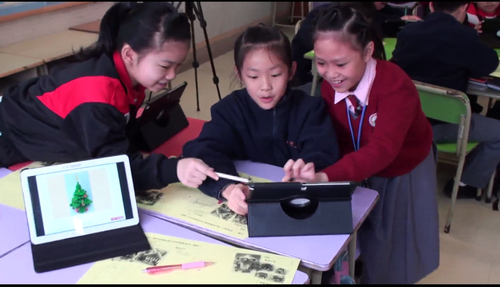
Students learn how to for example write a travel note in a virtual reality world using tablets.

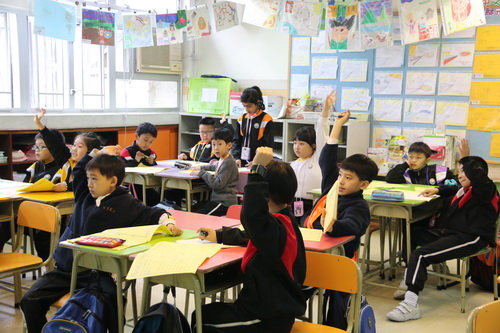
An interesting lesson makes learning more effective!

Students are participate in the learning activity and show what they have learnt.

Students use tablets to do detailed research and afterwards write a travel note.